
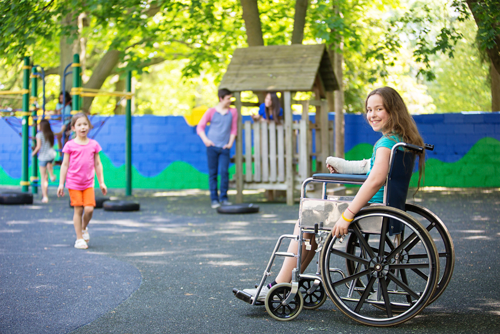
Handicap Accessible FallZone Playground Safety Surfacing
Special consideration should be given to providing handicap accessible playground surfaces in a play area that meets the ASTM Standard Specification for Determination of Accessibility of Surface Systems Under and Around Playground Equipment, ASTM F1951. Equipment selection and location along with the proper protective FallZone Safety Surfacing are key components to ensuring a safe opportunity for children with disabilities to play on the playground.
Playground surfaces along accessible routes, clear floor or ground spaces, and maneuvering spaces, must comply with the American Society for Testing and Materials (ASTM) F 1951-99 Standard Specification for Determination of Accessibility to Surface Systems Under and Around Playground Equipment. This standard assesses the accessibility of a playground surface by measuring the work an individual must exert to propel a wheelchair across the playground surface. The standard includes tests of effort for both straight-ahead and turning movements, using a force wheel on a rehabilitation wheelchair as the measuring device. To meet the standard, the force required must be less than that which is required to propel the wheelchair up a ramp with a slope of 1:14.
ASTM F 1951-99 establishes a uniform means to measure the characteristics of surface systems in order to
provide performance specifications to be used when selecting the proper FallZone materials for use as an accessible surface under and around playground equipment. Playground Surface materials that comply with this standard and are located in the fall-zone must also comply with ASTM F 1292. The test methods in this standard address access for children and adults who may traverse the surfacing to aid children who are playing. When a surface is tested it must have an average work per foot value for straight propulsion and for turning less than the average work per foot values for straight propulsion and for turning, respectively, on a hard, smooth surface with a grade of 7% (1:14).
Most of the loose fill playground surfacing materials do not meet the level of compliance for both impact attenuating surfaces and compaction for mobility devices like wood chips, sand, pea gravel and rubber mulch that the standards address but the materials, when tested to the ASTM Standards; do meet the definition of the new regulations. All loose fill surfacing requires daily raking to maintain the required depth of the material to ensure the safety of children. Replenishment is also required as loose fill gets packed down or kicked away. Often this type of maintenance does not take place, creating unsafe playgrounds.
Here are a few specifications and recommendations to consider for the proper ADA FallZone Safety Surfacing materials.
- What is the force of impact from a fall in a fall-zone, in and around playground equipment? The code
requirements are referenced and established by ASTM Standard 1292-99 and ASTM F 1292-04. These codes provide a uniform means to measure and compare characteristics of playground surfacing materials to determine whether materials provide a safe playground surface under and around playground equipment. These standards are also referenced when an accessible surface is required inside a play area fall-zone where a fall attenuating surface is also required. The standards cover the minimum impact attenuation requirements, when tested in accordance with Test Method F 355, for playground surface systems to be used under and around any piece of playground equipment from which a person may fall. - Where are the accessible Routes located both in and around playground components and to and from playgrounds themselves? These requirements can be found in ASTM F 1487 and ASTM 1487-01, which establishes a nationally recognized safety standard for public playground equipment to avoid injuries identified by the U.S. Consumer Product Safety Commission. ASTM 1487 defines the fall-zone as the ground area beneath and immediately adjacent to a play structure or play equipment that is designed for unrestricted Page 2 – Playground Surfacing Materials circulation around the equipment and on whose surface it is predicted that a user would land when falling from or exiting pertinent play structures or equipment. ASTM F 1487 identifies the play area standard when defining accessible routes, which overlap use zones that require fall attenuating surfaces. In short, if the fall-zone of a playground is not entirely surfaced with an accessible material, at least one accessible route within the fall-zone must be provided from the perimeter to all accessible play structures or components within the playground.
- What are the surface characteristics of playground surfaces that allow for compaction, propulsion and turning capabilities for mobility devices on playground surfaces? These standards are addressed in ASTM F 1951-99.
For more information on the proper ADA FallZone Safety Surfacing go to www.fallzonesafetysurfacing.com
Contact Your FallZone Surfacing Specialist Today For More Information
"*" indicates required fields
https://fallzonesafetysurfacing.com/fallzone-pouredinplace-playground-safety-surface/
https://fallzonesafetysurfacing.com/fallzone-bonded-rubber-playground-safety-surface/
https://fallzonesafetysurfacing.com/fallzone-synthetic-grass-playground-safety-surface/
https://fallzonesafetysurfacing.com/fallzone-splash-pads-playground-safety-surfaces/
[/et_pb_text][/et_pb_column][/et_pb_row][/et_pb_section]