
FallZone Poured-in-Place Rubber vs. Other Playground Surfacing: Which Is Best?
Facility managers, landscape architects, and parent groups frequently ask the same question: which playground surfacing is actually best? The honest answer is that “best” depends on the specific priorities of the project—safety consistency, accessibility, maintenance capacity, aesthetics, and total cost of ownership. This comparison examines the leading options side by side so decision-makers can match the surface to their real-world needs, with particular attention to FallZone Poured-in-Place and FallZone Synthetic Grass.
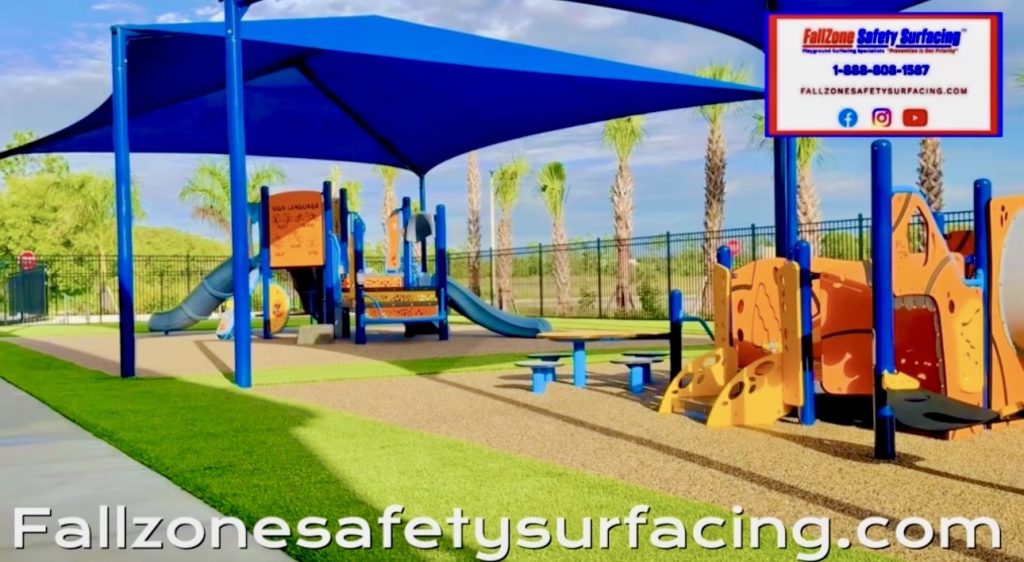
The Contenders
The most common commercial playground surfacing systems in the United States today are:
-
Rubber tiles
-
Engineered wood fiber (EWF)
-
Rubber mulch / shredded rubber
-
FallZone Synthetic Grass (with FallZone Safety Base)
Each can meet ASTM F1292 impact attenuation requirements when properly designed, installed, and maintained. Performance in the field, however, varies significantly.
Safety and Impact Attenuation
All systems that claim compliance are tested under ASTM F1292. The practical difference lies in consistency over time.
FallZone Poured-in-Place: is a continuous, bonded system. Once installed at the correct thickness, the impact protection remains relatively uniform across the entire surface. There are no particles to kick out from under swings or slide exits.
Loose-fill materials: such as EWF and rubber mulch rely on depth. As children play, the material migrates, creating thin spots in high-use areas and piles elsewhere. Without regular raking and replenishment, critical fall height ratings can no longer be met.
Rubber tiles: Outdated but can perform well, but tiles may shift or separate at the seams.
FallZone Synthetic Grass: Great safety & maintenance performance. FallZone engineers its FallZone Safety Base specifically for playground its applications.
For sites where consistent, predictable safety is the top priority, unitary surfaces—especially FallZone Poured-in-Place—generally hold a major advantage.
Accessibility and ADA Compliance
The Americans with Disabilities Act requires that playground surfaces allow children with disabilities to reach and use play components. ASTM F1951 tests firmness and stability for accessibility.
FallZone Poured-in-Place is inherently firm, stable, and seamless. Wheelchairs, walkers, and strollers move across it with minimal resistance. Rubber tiles can also meet accessibility standards when properly installed and maintained.
Loose-fill materials struggle. Even when fresh, wood fiber and rubber mulch create rolling resistance. As they compact or displace, they often fail accessibility criteria. FallZone Synthetic Grass can be fully accessible when the complete system is designed and installed for that purpose.
Inclusive playgrounds that prioritize universal access almost always specify unitary surfaces such as FallZone Poured-in-Place or FallZone Synthetic Grass.
Maintenance Requirements
Maintenance is where the differences become most visible over time.
FallZone Poured-in-Place requires minimal routine care: occasional sweeping or rinsing, inspection for damage, and rare localized repairs. There is no material to rake or replenish.
Rubber tiles need seam inspection and occasional tile replacement.
Engineered wood fiber demands frequent raking to maintain depth and levelness, periodic addition of new material, and attention to drainage and borders. Rubber mulch requires less frequent replenishment than wood fiber but still needs redistribution and containment maintenance.
FallZone Synthetic Grass needs debris removal, occasional infill adjustment if used, and monitoring of the shock pad—still far less labor-intensive than loose-fill options.
Facilities with limited maintenance staff or budgets often find that the higher initial cost of FallZone Poured-in-Place or FallZone Synthetic Grass is offset by years of lower labor and material expense.
Durability and Lifespan
Under normal commercial use, FallZone Poured-in-Place typically lasts 10–15 years or longer before major renovation is needed. High-quality systems resist UV degradation, cracking, and wear when installed correctly.
Rubber tiles often last 8–12 years, with individual sections replaceable.
Engineered wood fiber may need significant top-dressing every 1–3 years and full replacement of the upper layer more frequently. Rubber mulch lasts longer than wood fiber but still requires ongoing attention. FallZone Synthetic Grass systems commonly last 8–12 years or more depending on traffic and climate when properly maintained.
Aesthetics and Design Flexibility
FallZone Poured-in-Place offers the greatest design freedom. Colors can be mixed, patterns created, logos incorporated, and graphics used to define zones or support wayfinding. The seamless surface looks finished and intentional.
Tiles provide color options but limited graphic capability. Loose-fill materials are essentially monochromatic and functional rather than decorative. FallZone Synthetic Grass delivers a consistent, natural green appearance that many communities prefer.
Cost Considerations
Installed costs vary by region, thickness, site conditions, and design complexity. Approximate ranges in recent years have been:
-
Engineered wood fiber: lowest initial cost
-
Rubber mulch: moderate
-
Rubber tiles: moderate to high
-
FallZone Synthetic Grass: moderate to high
-
FallZone Poured-in-Place: highest initial cost
When total cost of ownership over 10–15 years is calculated—including maintenance labor, material replenishment, and potential liability exposure—FallZone Poured-in-Place systems frequently prove competitive or less expensive for high-use sites.
Which Surface Is Best for Your Project?
-
High-traffic school or public park with accessibility requirements → FallZone Poured-in-Place is usually the strongest overall choice.
-
Tight capital budget and available maintenance staff → Engineered wood fiber can work if rigorously maintained.
-
Desire for a natural green appearance with low daily upkeep → FallZone Synthetic Grass.
-
Smaller area or need for easy sectional repair → Rubber tiles.
-
Balance of cost and durability with moderate maintenance capacity → Rubber mulch.
There is no universal winner, but there is a clear trend: as expectations for safety consistency, accessibility, and reduced maintenance rise, more projects are specifying FallZone Poured-in-Place or FallZone Synthetic Grass.
Learn more about FallZone Poured-in-Place and FallZone Synthetic Grass playground surfacing systems, or contact FallZone Safety Surfacing today for a free consultation on your next project.
Contact Your FallZone Surfacing Specialist Today For More Information
"*" indicates required fields