
Complete Guide to Playground Surfacing: Options, Safety Standards & Best Practices
Discover everything you need to know about playground surfacing — types, ASTM standards, critical fall heights, costs, and how to choose the safest surface for schools, parks, and childcare centers.
Choosing the right playground surfacing is one of the most important decisions a school, park department, childcare center, or community organization will make. The surface under the equipment does far more than provide a place to land. It determines whether a fall results in a minor scrape or a serious head injury, whether the playground is truly accessible to children of all abilities, and how much time and money the facility will spend on maintenance for the next decade.
Every year, hundreds of thousands of children are treated for playground-related injuries in the United States. The majority of those injuries involve falls to the surface. That is why proper playground surfacing is not optional—it is a fundamental safety requirement. This comprehensive guide explains what playground surfacing is, the standards that govern it, the main material options available, and how to select the best system for your specific project.

Why Playground Surfacing Matters
Playground equipment is designed to challenge children’s physical abilities. Climbing structures, slides, swings, and overhead bars all create opportunities for falls. The Consumer Product Safety Commission (CPSC) has long recognized that the surface beneath the equipment is the single most effective way to reduce the severity of those falls.
Impact attenuation—the ability of a surface to absorb and dissipate the energy of a falling child—is the core performance requirement. Surfaces that lack adequate cushioning can turn a routine fall into a concussion, fracture, or worse. Beyond safety, modern playground surfacing must also support accessibility, durability under heavy use, drainage, and long-term cost control.
Critical Fall Height and Impact Attenuation Explained
Critical fall height is the maximum height from which a child can fall onto a surface and still have a reasonable chance of avoiding a life-threatening head injury. It is determined through laboratory testing that measures two key values: Gmax (peak deceleration) and HIC (Head Injury Criterion).
Under ASTM F1292, the industry standard for impact attenuation of playground surfacing, a surface must keep Gmax at or below 200 and HIC at or below 1,000 when tested from the critical fall height. The highest accessible play platform or the top of a swing seat usually sets the critical fall height for the entire use zone. A surface that is rated for only six feet cannot safely protect a child falling from an eight-foot platform, no matter how soft it feels underfoot.
Thickness, material density, and installation quality all influence whether a surface actually achieves its rated critical fall height in the field. Thin spots, compaction, or poor sub-base preparation can reduce performance dramatically.
Key Safety and Accessibility Standards
Several standards and guidelines govern playground surfacing in the United States:
-
ASTM F1292 – Standard Specification for Impact Attenuation of Surfacing Materials Within the Use Zone of Playground Equipment. This is the primary performance test for safety.
-
ASTM F1951 – Standard Specification for Determination of Accessibility of Surface Systems Under and Around Playground Equipment. It measures whether a surface is firm and stable enough for wheelchair users and other mobility devices.
-
CPSC Public Playground Safety Handbook – Provides practical guidance on use zones, fall heights, and recommended materials.
-
ADA Standards for Accessible Design – Requires accessible routes and play components. Surfaces must allow independent use by children with disabilities.
Any surface claimed to be “safe” or “compliant” should be able to provide current test data from independent laboratories demonstrating performance under the relevant ASTM standards.
Unitary vs. Loose-Fill Playground Surfacing
Playground surfacing falls into two broad categories.
Loose-fill materials consist of individual particles that can be moved or displaced. Common examples include engineered wood fiber (EWF), rubber mulch, sand, and pea gravel. These materials are generally less expensive to install initially but require ongoing maintenance to maintain depth and levelness. They can also create accessibility challenges because the surface shifts under wheels and feet.
Unitary surfaces are continuous, bonded systems. FallZone Poured-in-Place and FallZone Synthetic Grass are leading examples of high-performance unitary options. Once installed, they stay in place, provide consistent impact protection, and offer superior accessibility. Unitary surfaces typically cost more upfront but often deliver lower long-term ownership costs because they require far less maintenance.
Major Playground Surfacing Options
FallZone Poured-in-Place
FallZone Poured-in-Place is a two-layer system installed on site. A resilient base layer of recycled rubber provides the bulk of the impact absorption, while a colored EPDM or TPV wear layer delivers durability, UV resistance, and design flexibility. It is seamless, fully ADA-compliant when properly installed, and can be customized with colors, patterns, and graphics. FallZone Poured-in-Place is widely regarded as one of the highest-performing options for schools, parks, and inclusive playgrounds.

Rubber Tiles
Prefabricated interlocking or butted tiles made from recycled rubber. They offer good impact attenuation and relatively easy repair of individual damaged sections. Seams and potential for movement over time are the main drawbacks compared with seamless poured systems such as FallZone Poured-in-Place.
Engineered Wood Fiber (EWF)
A processed wood product manufactured specifically for playground use. When installed at the correct depth and maintained properly, EWF can meet ASTM F1292 requirements. It has a natural appearance and lower initial cost, but it compacts, decomposes, and requires frequent replenishment and raking. Accessibility performance declines as the material migrates or becomes uneven.
Rubber Mulch / Shredded Rubber
Made from recycled tires. It provides better impact absorption than wood fiber at comparable depths and resists decomposition. Like other loose-fill materials, it needs containment borders and regular redistribution.
FallZone Synthetic Grass
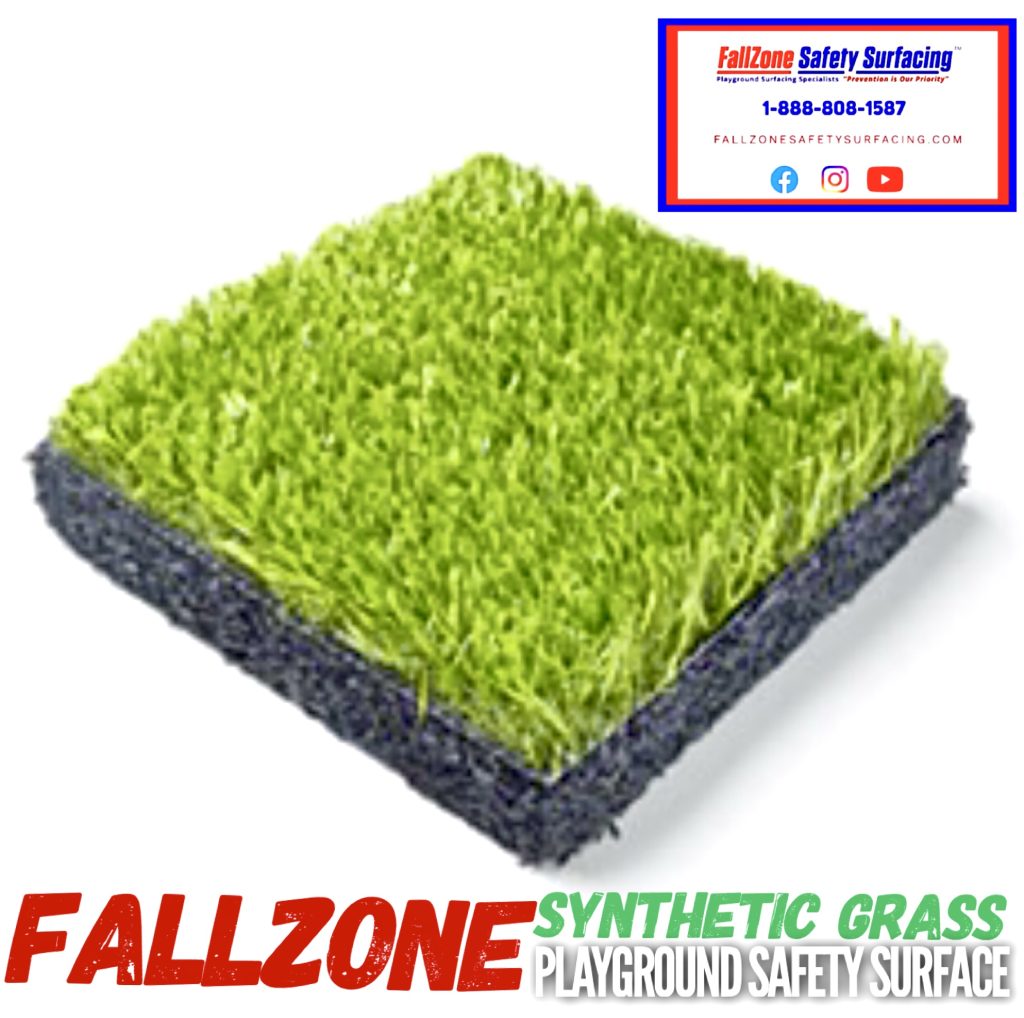
FallZone Synthetic Grass is an engineered turf system paired with a high-performance shock-absorbing pad. It delivers a consistent green appearance, excellent drainage, and reliable impact attenuation when properly specified. FallZone Synthetic Grass is designed specifically for playground use and stands apart from ordinary landscape turf.
Sand, pea gravel, grass, and bare soil do not meet modern safety standards for public playgrounds and should not be used under elevated equipment.
How to Choose the Right Playground Surfacing
Start with the critical fall height of the equipment. The surface must be rated for at least that height across the entire use zone. Next, evaluate accessibility requirements. If the playground must serve children with mobility impairments, a unitary surface such as FallZone Poured-in-Place or FallZone Synthetic Grass is almost always the better choice.
Consider expected traffic volume, local climate, available maintenance staff, and total budget over a 10- to 15-year period rather than installation cost alone. High-traffic school playgrounds and destination parks usually benefit from the durability and low maintenance of FallZone Poured-in-Place. When a natural green look is preferred, FallZone Synthetic Grass provides an excellent alternative. Smaller or lower-budget sites may start with engineered wood fiber, provided a realistic maintenance plan is in place.
Finally, work with an experienced playground surfacing installer who understands both the product and the standards. Proper sub-base preparation, drainage, and thickness control are as important as the material itself.
Playground surfacing is a long-term investment in child safety and facility performance. The best surface is the one that reliably meets the critical fall height of the equipment, remains accessible, and can be maintained within the owner’s resources. FallZone Poured-in-Place and FallZone Synthetic Grass have become preferred solutions for many schools, parks, and childcare centers precisely because they balance these factors more effectively than most alternatives.
Learn more about FallZone Poured-in-Place and FallZone Synthetic Grass playground surfacing systems, or contact FallZone Safety Surfacing today for a free consultation on your next project.
Contact Your FallZone Surfacing Specialist Today For More Information
"*" indicates required fields